
What Jinyuan’s Ceramic Fiber Blanket Production Line can really do?
Doing aluminum silicate needle punched blanket production lines for over a decade – let me tell you what Jinyuan’s equipment can really do?
First, why so many people want to get into the aluminum silicate needle punched blanket business now?
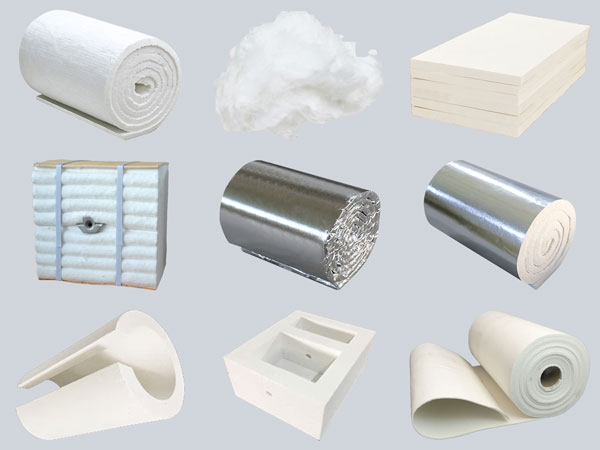
To be honest, I get calls all the time. Domestic and international. Some are new to the industry and want to start with a small line to test the waters. Others have been making refractory materials for years, buying blankets from outside, and now want to produce their own. But in the end, it all comes down to one question: Is this aluminum silicate needle punched blanket business still worth getting into?
My answer is yes. Definitely yes. But not blindly.
Just look at the numbers. The global aluminum silicate insulation materials market was about $856.4 million in 2024. Some forecasts say it could reach $1.42 billion by 2032. That’s a CAGR of around 6.5%. That number doesn’t look huge, but remember – industrial products don’t grow like consumer goods. A steady 6.5% is actually very solid.
So why the growth? Let me tell you two real stories I saw with my own eyes.
Last year I visited a long-time customer’s steel plant. Before, the outer wall temperature of their furnace often exceeded 120°C. Workers could barely stand it in summer. Later they switched to 128 kg/m³ density blankets made on their own Jinyuan line. The outer wall temperature dropped below 70°C. They did the math – the natural gas they saved in one year alone could buy nearly half of their production line. Does this product have a market? Absolutely.
Another customer runs a petrochemical engineering company. They used to import blankets from Europe. Expensive, sure, but the real pain was lead times – often three to four months. Then they came to us, bought a production line, and started making their own. Their cost dropped by over 40%. Now they not only use the blankets themselves but also sell to smaller chemical plants nearby.
So yes, as long as you have good equipment, consistent quality, and solid cost control, this market has plenty of room.
What exactly is an aluminum silicate needle punched blanket?

A lot of people ask me this question, and online explanations are often way too complicated. Let me put it simply.
You take two powders – alumina and silica – melt them at around 1700–1850°C, spin them into fine fibers, lay those fibers into layers, then punch them with thousands of barbed needles to mechanically interlock the fibers. No glue, no chemical binders. What comes out is a resilient, high-temperature blanket.
Why “needle punched”? Because the needles do the bonding. They go up and down, pushing fibers into each other, creating a strong blanket without any smell or smoke when heated. And it handles very high temperatures.
Here are the key benefits in plain language:
- High temperature rating – Standard grade works up to 1000°C, premium grades up to 1350°C or more
- Low thermal conductivity – Much better than rock wool at the same thickness
- Excellent thermal shock resistance – Open the furnace door and charge cold material? Most materials crack. This one doesn’t.
- Lightweight – One person can carry a roll. No crane needed for installation.
- Asbestos‑free and environmentally friendly – Meets global safety standards
Where is it used? Furnace linings, boiler insulation, pipe wrapping, fireproof door fillers, even aerospace applications.
How Jinyuan’s ceramic fiber blanket production line works – step by step?
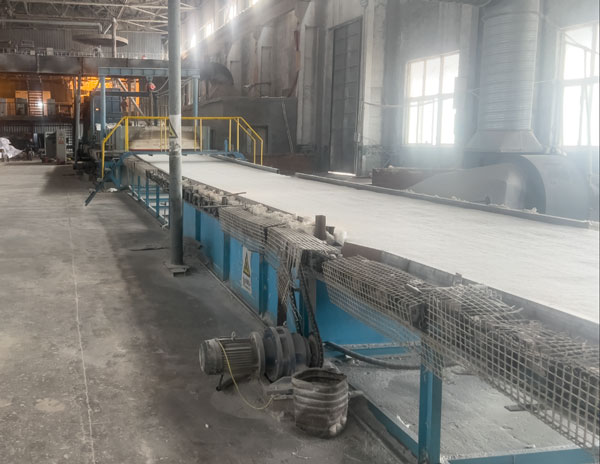
First, a quick background. Our company is Jinyuan, based in Shandong, China. We’ve been making industrial machinery for over twenty years, and specifically ceramic fiber equipment for more than fifteen. I come from a technical background – drafting, assembly, commissioning – so I’m not just a salesperson. I know how these machines work.
Let me walk you through the entire line.
Step 1: Raw material batching – looks simple, but this is where most problems start
A lot of small buyers ignore the batching system. They think it’s just weighing stuff and dumping it in. But I tell you, if your batching is off, everything after it is wasted.
Our system is fully automatic. Alumina and silica powders sit in different silos, each with a screw feeder that delivers at a stable rate. We hold the batch weight error to under 0.3%.
Why so tight? Because different customers need different blanket grades. Standard grade has lower alumina content. High‑alumina grade needs 50%+ alumina. Zirconia grade requires adding zirconium dioxide. If your batching system has too much variation, one batch comes out as standard grade, the next becomes high‑purity – the customer can’t use them interchangeably.
So we designed the batching section as a separate module with anti‑clogging devices on every powder line. In humid climates, powder can cake and block the pipes. We’ve fixed that. Many other equipment suppliers don’t even think about these details.
Step 2: Melting – hotter than you probably imagine
The batched powder goes into a melting furnace. We offer two types: electric resistance furnace and gas arc furnace.
The electric furnace uses molybdenum electrodes and can reach 1850°C. The advantage is very stable temperature and zero exhaust gases. Perfect for areas with strict environmental regulations. The downside? Electricity costs can be higher.
The gas furnace uses natural gas and reaches over 1750°C. It’s cheaper to run where gas is inexpensive. But if your natural gas supply is unreliable, I’d still recommend the electric version.
Either way, every furnace we supply includes a nitrogen protection system. Why? Because molten material oxidizes when exposed to air. Oxidized impurities in the fiber lower its temperature rating. The nitrogen flows from the bottom and pushes air out. We’ve improved this design over three generations to make it really effective.
The outlet is a molybdenum discharge spout. Molybdenum handles extreme heat but hates oxygen – so we keep nitrogen flowing around it at all times. One of our customers has used the same spout for three years without replacement because they never let the nitrogen stop.
Step 3: Fiberizing – the thickness of your fibers is decided here
Molten material drips from the spout onto a high‑speed spinning disc. The disc spins at several thousand RPM. Centrifugal force throws the melt outward, and it cools into fine fibers as it flies.
This step is the heart of the line. Fiber diameter needs to be controlled between 2 and 5 microns. Too thick, insulation performance drops. Too thin, the blanket lacks strength. We make our own spinning discs with custom tooling – the alloy composition and disc angle have been tested over and over until the fiber uniformity matches or beats many European old‑line machines.
We use multi‑stage fiberizing – typically three or four discs in series. The first stage produces coarser fibers, the next stage pulls them finer, and so on. This creates a blend of fiber lengths that gives the best needling performance and final blanket strength.
Step 4: Web forming – don’t underestimate this; thickness uniformity depends on it
The fibers are blown by a fan onto a moving mesh conveyor. Under the mesh is a suction box that pulls the fibers down so they don’t float away. The layer that forms is called a “web.”
Our web former includes an automatic edge alignment system. Many older machines drift to one side as they run, wasting material when you trim the edges later. Our sensors constantly monitor the web position and adjust automatically. Waste can be reduced by at least 5% – maybe more.
The conveyor speed is infinitely adjustable. Want a thicker blanket? Slow the conveyor. Thinner blanket? Speed it up. Thickness from 6mm up to 100mm is achievable.
Step 5: Needling – the name sounds aggressive, but it makes the blanket strong
The web goes from the former into the needling machine. Ours is double‑sided needling.
Here’s how it works: needle boards from above punch down, pushing fibers downward. Boards from below punch up, pushing fibers upward. The repeated penetration tangles the fibers together, creating a solid blanket.
The needles themselves matter. We use German‑brand needles or our own custom high‑carbon steel needles, each with barbs. The barb orientation and position are carefully designed to tangle fibers without cutting or breaking them.
Needling density can be adjusted. For low‑density blankets (64 kg/m³), we run lower frequency and faster line speed. For high density (160 kg/m³), frequency goes up and speed comes down.
Some customers ask: can one line handle multiple densities? Of course. The PLC control system stores several recipes. The operator selects the desired density on the touchscreen, and the line adjusts itself automatically. Changeover takes about ten minutes.
Step 6: Heat treatment – basically baking the blanket to set its properties
After needling, the blanket is formed but still has some organic lubricants left from the fiberizing process. If you don’t burn those off, the blanket will smoke the first time the customer heats it. That gets you angry phone calls.
So the blanket goes through a heat treatment furnace – typically several hundred to over a thousand degrees Celsius. Inside, organic residues burn off, the fibers undergo microcrystallization, and the blanket’s temperature rating and dimensional stability lock in.
Our furnace is divided into multiple temperature zones, each independently controlled. The blanket heats up gradually as it moves through. Sudden temperature shock can cause the blanket to crack or delaminate. Cheap furnaces have only one zone – they save cost, but the product quality suffers.
Step 7: Cutting and winding – finished product ready to ship
The heat‑treated blanket passes through slitting knives to cut it to the required width. Standard widths are usually 610mm or 600mm. If your customers need special widths, we can arrange extra knife positions during design.
Then a cross cutter – either fixed length or automatic length measurement with flying cut.
Finally, winding. Our winder has tension control so the rolls come out evenly tight with a neat appearance. Packaging can be heat shrink film or woven bags, according to your needs.
What specifications can our line deliver? Here’s a simple table
Let’s not overcomplicate it:
| Parameter | Range | Notes |
|---|---|---|
| Annual capacity | 1,000 – 5,000 tons | Scaled to your needs |
| Line width | 600 – 2,400 mm | Wider = higher output |
| Blanket thickness | 6 – 100 mm | Common: 10, 20, 25, 50 mm |
| Density | 64, 96, 128, 160 kg/m³ | Standard industry densities |
| Fiber diameter | 2 – 5 μm | Finer for insulation, coarser for strength |
| Control system | PLC + HMI touchscreen | Siemens or high‑quality domestic |
| Installed power | 300 – 800 kW | Depends on furnace type |
| Floor space | 1,500 – 4,000 m² | Includes raw material, line, finished goods |
| Operators per shift | 4 – 6 people | Mostly monitoring |
What blanket grades can you produce? All the mainstream ones
One advantage of our line design is that you can switch between grades without major reconfiguration. Just change the recipe and adjust a few parameters. We support:
- Standard Grade – Classification temp 1260°C, service up to 1000°C. Most affordable, highest volume. Good for general industrial insulation.
- High‑Purity Grade – Lower impurities, better high‑temperature performance. Same 1260°C classification but lower shrinkage.
- High‑Alumina Grade – Alumina content above 50%, classification 1400°C. For furnaces with higher temperature requirements.
- Zirconia Grade – ZrO₂ added, classification up to 1430°C, service up to 1350°C. The top end – highest price but also highest margin.
Many customers run standard grade most of the time and switch to high‑alumina or high‑purity for special orders. Our equipment handles this flexibly.
Why choose Jinyuan? Here are the real advantages
1. Complete turnkey – not just individual machines
Some suppliers sell you a furnace and say “oh, we don’t make needlers, let us recommend someone else.” Then you have to assemble everything yourself, only to find the furnace speed doesn’t match the web former. You end up stopping production constantly to adjust.
We do it differently. We take care of everything – plant layout, utilities, raw material storage, finished product packaging, and all equipment integration. You get a complete line. Connect power, load raw materials, and start producing.
The fastest project I’ve personally handled – from contract signing to first good product – was three months. That customer already had the building ready. Typically we say four to six months.
2. Reliable equipment – not constantly breaking down
I’ve been in this industry for over fifteen years. The mistakes we’ve made along the way are more than some new companies have even seen. Each generation of our machines improves on the last.
Take the needle board guide rails. We started with ordinary steel. After six months, they weren’t flat anymore. Now we use hardened alloy steel. After three years, the precision is still good.
Or the electrode seals on the melting furnace. They used to leak. We redesigned the sealing system three times. Now they basically don’t leak.
These details aren’t visible on day one. But after three or five years, the difference is huge. That’s why our repeat customer rate is high – once they use our equipment, they know it’s solid.
3. Support doesn’t end after delivery
When we install a line, our engineers go on site. Typically they stay two to four weeks until you produce your first good batch. Then they train your operators – not just a quick show‑and‑tell, but real hands‑on training until they can operate and handle common faults by themselves.
After that, if something comes up, a phone call or WeChat video gets you remote support. If we can’t solve it remotely, we send an engineer back. We also keep an inventory of common spare parts – needles, heating elements, seals, and so on – so we can ship quickly.
One customer in Saudi Arabia had a motor failure. They couldn’t find an exact replacement locally. We shipped from China. Including customs clearance, delivery took twelve days. They managed with an old motor during that time. If they had bought from a less prepared supplier, the wait could have been two months.
4. Lower energy costs than you might expect
Electricity and gas prices keep rising. Your production line’s energy efficiency directly affects your profit. We pay close attention to this in our designs.
Our furnace shells have thick insulation – outer wall temperature stays below 60°C, so heat loss is low. The heat treatment furnace has waste heat recovery that preheats incoming cold air.
Also, the control system automatically adjusts fan speed and heating power according to production volume. When you run at reduced capacity at night, the line slows down automatically instead of running full power with empty load.
One customer compared our line against another line of similar capacity. They saved about 20,000 kWh per month with ours. That’s 240,000 kWh a year.
5. Customization – we work with you
Not every plant is the same. Not every target market is the same.
If your floor space is limited, we can lay out the line in an L‑shape or U‑shape to save space. If you mainly make thin blankets, we can reduce the number of needling stations. If you export to Europe, we can fit CE‑certified electrical components.
No matter what you ask for, we always start with the same questions: How many tons per day do you want to produce? What density and thickness are your main products? What’s your local voltage? How humid is your summer?
Then we draw up plans and a proposal. That’s the responsible way to do it.
Who will buy the blankets you produce? These are stable markets
If you set up your own line, you need to know the end‑users. Here’s who buys these blankets.
Steel mills – The biggest market. Reheating furnaces, heat treatment furnaces, ladle covers. Steel mills consume large volumes and typically replace linings every six to twelve months.
Petrochemical plants – Cracking furnaces, reformers, reactors. High requirements – usually high‑purity or better – but good pricing and long‑term contracts.
Power plants – Boilers, flue ducts, steam pipes. They usually want higher density – 128 or 160 kg/m³.
Ceramic and glass factories – Kiln roofs and walls. High temperature requirements – zirconia grade is common here.
Fire door manufacturers – Core filling. Thermal performance requirements are moderate, but the material must be odorless and non‑toxic. Standard grade works fine.
Also marine fireproofing, appliances, automotive exhaust insulation… The applications are wider than you think. Get your quality consistent, and you won’t struggle to find customers.
Frequently asked questions – answered here
Q: Are raw materials hard to source?
A: No. Alumina and silica are common industrial minerals available everywhere. We can also introduce you to our long‑term suppliers if you need contacts.
Q: How many people are needed per shift?
A: Typically one person watches the melting furnace, one adjusts the needling and forming, one checks quality at the cutting/winding end, plus a shift supervisor. Four people total is normal.
Q: Can you install overseas?
A: Yes. Our engineers have been to Russia, Saudi Arabia, India, Indonesia, Vietnam, Turkey, and other countries. Travel and living costs are specified in the contract, usually billed per day.
Q: What is the warranty period?
A: One year for the complete line. Three years for major structural components. Consumables like needles and heating elements are not covered under warranty.
Q: Can I start with a smaller line and expand later?
A: Yes. We design with future expansion in mind. For example, you might buy a 1,000 t/y line now but have the building and electrical supply sized for 3,000 t/y. Adding equipment later is straightforward.
A few honest words at the end
I’ve been doing this for more than a decade. I’ve seen too many buyers choose equipment based only on price – whoever is cheapest gets the order. Then the line arrives. Material leaks here, stoppages there. The blanket comes out uneven. Customers reject the product. It’s painful to watch.
I’ve also seen others buy the right equipment, work hard for three years, expand from one line to three, and grow from a small workshop into a respected refractory supplier in their region.
Equipment is like this: spend a little more upfront and you’ll save yourself endless headaches later. Bargain hunt, and you’ll pay for it in downtime and lost customers.
Jinyuan’s equipment is not the cheapest on the market. But it’s fair for what it delivers. Come visit our factory. We’ll run the line for you. Ask any technical question – we’ll answer it straight. Match our specs against anyone else’s. Only when you’re satisfied do we sign a contract. That’s how we do business.
If you want detailed technical data, product videos, or a layout proposal for your specific factory, just contact me.
Jinyuan *Aluminum silicate needle punched blanket production lines – 15+ years of experience, customers worldwide, factory visit always welcome.