
You Can Trust – Jinyuan’s Ceramic Fiber Blanket Production Line Safety
Ceramic fiber production line safety alway the most important for the factory

Last year, a customer called me. He bought a cheap production line from somewhere else. Six months in, his furnace overheated. The protection system? It never worked. The temperature climbed past 2000°C. Wires melted. The building almost caught fire. Nobody got hurt – lucky. But he lost two months of production. And his insurance company? They told him to find another provider.
This happens more than you think. When you are dealing with molten material at 1800°C, safety is not a luxury. It is survival.
I am from Jinyuan. We have been building ceramic fiber blanket production lines for over fifteen years. But today I am not going to talk about output or efficiency. I am going to talk about something more important – safety.
Because a production line that burns down your factory is not a good deal at any price.
The Process – What Makes It Dangerous?
Before we talk about safety features, let us understand what we are dealing with.
A ceramic fiber blanket production line melts alumina and silica powders at 1700°C to 1850°C. That is hotter than lava. Then it spins that molten material into fine fibers. The fibers go through needling machines with thousands of sharp needles moving up and down. Then the blanket goes through heat treatment furnaces.
Every step has risks:
- High temperature burn risks from furnaces and molten material
- Electrical hazards from high-power heating systems
- Fire and explosion risks from overheating or electrical faults
- Respiratory hazards from airborne fibers and dust
- Mechanical hazards from moving parts and sharp needles
- Noise hazards from spinning discs and needling machines
A good ceramic fiber blanket production line addresses every single one of these risks. A bad one? It ignores most of them.
Let me walk you through how Jinyuan designs safety into every part of our ceramic fiber blanket production line.
High Temperature Safety – More Than Just Hot Surfaces
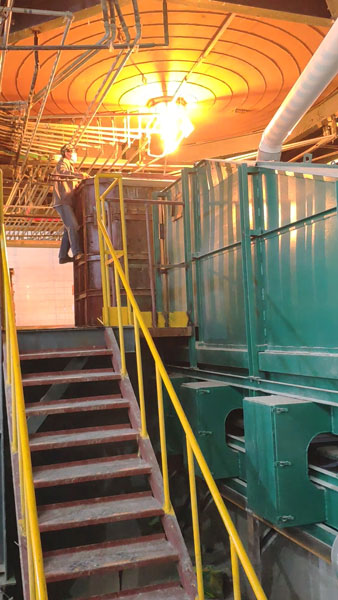
The melting furnace is the heart of any ceramic fiber blanket production line. It is also the most dangerous part.
In a poorly designed furnace, the outer shell can reach temperatures over 100°C. I have seen it myself. A worker brushes against it and gets a serious burn. One customer showed me photos of his operator’s arm after touching a furnace shell. It was not pretty.
That is why our furnaces have thick, multi-layer insulation. We keep the outer shell temperature below 60°C – safe to touch. The insulation is backed by a durable metal shield that protects against accidental contact.
But surface temperature is just the beginning. You need to control the melt itself. Our furnaces use closed-loop temperature control systems that maintain a precise temperature range. If the temperature goes outside the safe limit, the system triggers an alarm and automatically reduces power.
One crucial safety feature that is often missing in cheap ceramic fiber blanket production lines is the nitrogen protection system. The molybdenum discharge spout – where molten material exits the furnace – oxidizes rapidly if exposed to air. Oxidation causes the spout to degrade and eventually fail. But worse, it can create cracks that leak molten material. Imagine that – 1800°C liquid dripping onto your factory floor.
Our nitrogen protection system flows an inert gas curtain around the spout at all times. No oxidation. No cracks. No molten leaks. It is simple engineering, but it saves lives.
Electrical Safety – Hidden Dangers
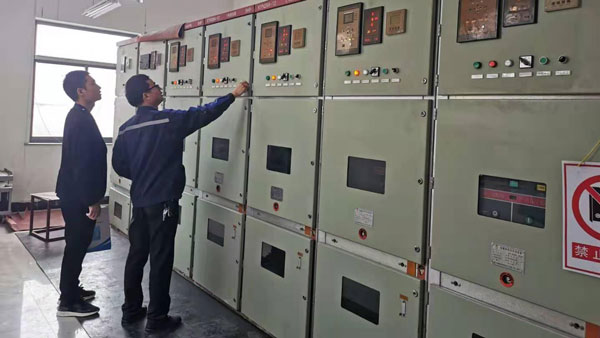
The melting furnace in a ceramic fiber blanket production line draws massive amounts of power – hundreds of kilowatts. That much electricity is dangerous if not managed properly.
Our control cabinets are IP54 rated, meaning dust and water splashes do not get in. All high-voltage components are isolated behind locked doors. Only trained operators have keys. Emergency stop buttons are placed every few meters along the entire ceramic fiber blanket production line. If something goes wrong, you stop the whole line instantly.
But the most important electrical safety feature is the limit controller.
Limit controllers monitor temperature independently from the main control system. If the main temperature controller fails – and they do fail sometimes – the limit controller steps in. It has its own sensor, its own power supply, and its own relay. When temperature exceeds a preset safe limit, the limit controller cuts power to the heating elements. Not a soft shutdown – a hard cut. The kind that stops overheating before it starts a fire.
We follow NFPA 86 standards for our furnace safety systems. NFPA 86 is the US National Fire Protection Association standard for ovens and furnaces. It requires limit controllers on every heated system used for material processing. It is not optional – it is the law in many countries.
And here is the key – limit controllers require manual reset after a fault. Temperature goes too high? System shuts down. Now you have to physically go to the control panel, diagnose what went wrong, and manually reset the limit controller. This forces you to investigate the problem instead of just hitting “restart” and hoping for the best.
Many cheap ceramic fiber blanket production line manufacturers skip limit controllers to save a few hundred dollars. That is like removing the brakes from a car to save weight. It is insane.
Fire Safety – Preventing the Unthinkable
If you are melting material at nearly 2000°C, fire is always a risk. Even a small electrical fault can ignite dust or lubricants.
Our furnaces and heat treatment ovens include independent overtemperature protection beyond just the limit controller. We install thermal fuses that physically melt if the temperature gets too high. Once melted, they have to be replaced. It is a last-resort backup that works even if every other system fails.
The material we use for furnace construction is fire-resistant. The electrical cables are rated for high temperatures and protected inside metal conduits. We also include pressure relief mechanisms on the furnace – because if something does go wrong, you want the pressure to release safely instead of blowing up the vessel.
One more thing. The ceramic fibers themselves are non-flammable. That is good. But the organic lubricants used in the fiberizing stage? Those can burn. Our heat treatment stage burns them off intentionally – before the blanket ever reaches the customer. We do it in a controlled environment with proper exhaust and temperature management. No surprises.
Mechanical Safety – Stopping Moving Parts
A ceramic fiber blanket production line has many moving parts. The fiberizing disc spins at thousands of RPM. The needling machine has thousands of needles moving up and down dozens of times per second. The conveyor belts run continuously.
All these moving parts can cause serious injury if you get caught in them.
We put safety guards on every machine. These guards are interlocked – if you open them, the machine stops immediately. No exceptions. You cannot bypass them without a special tool and a supervisor’s override.
The needling machine is especially dangerous – thousands of sharp needles moving fast enough to punch through flesh and bone. Our needle loom includes light curtains that detect when a hand enters the danger zone. The machine stops faster than you can blink.
On the fiberizing disc, we use reinforced enclosures. If a disc fails at high speed – which is rare but possible – the enclosure contains the fragments. Without an enclosure, disc fragments become high-speed projectiles. I have heard stories. They are not stories you want to be part of.
Fiber and Dust Control – Protecting Your Workers’ Lungs
This is the safety issue that people do not talk about enough.
Refractory ceramic fibers – the same fibers your ceramic fiber blanket production line makes – can be hazardous if inhaled. The National Institute for Occupational Safety and Health (NIOSH) has studied this extensively. Approximately 31,500 workers in the US alone are potentially exposed to refractory ceramic fibers during manufacturing, handling, and installation.
Based on animal studies, NIOSH concludes that refractory ceramic fibers are a potential occupational carcinogen. The NIOSH recommended exposure limit is 0.5 fiber per cubic centimeter of air over a 10-hour shift. Below that level, the risk of adverse health effects – from eye irritation and upper respiratory issues to potential lung cancer risk – is minimized.
But how do you keep exposure that low?
You need engineering controls built into your ceramic fiber blanket production line. Not afterthoughts – real design.
Our fiberizing and web forming areas are enclosed. This is not difficult – it is just sheet metal and seals. But many manufacturers skip it to reduce cost.
We install local exhaust ventilation hoods at every point where fibers are released – the fiberizing spinner, the web former, the needling machine. These hoods are connected to dust collection systems with HEPA filters.
Workers still need personal protective equipment – N95 masks, gloves, safety glasses – but the goal is to remove the hazard at the source, not just protect the worker. That is called hierarchy of controls, and it is how safety should be done.
In cutting and finishing areas, fiber dust is also a problem. We include dust extraction ports on the slitting and cutting equipment. If you are cutting with power tools, those tools should be equipped with dust collection systems. And never use compressed air to clean up fiber dust – it just spreads it around. Use HEPA vacuums instead.
One more thing about dust – keep work areas clean. Fiber dust that settles on surfaces gets disturbed and becomes airborne again. Regular cleaning with proper methods makes a huge difference.
Emergency Systems – When Things Go Wrong
No matter how well you design a ceramic fiber blanket production line, things can still go wrong. Power outages happen. Sensors fail. People make mistakes.
That is why we design multiple layers of emergency protection.
Emergency stops – Red buttons everywhere along the line. Push one, the whole ceramic fiber blanket production line stops instantly.
Fire suppression – Our control cabinets include fire suppression systems that activate automatically if a fire is detected inside.
Gas detection – If you use a gas-fired furnace, we install gas detectors that shut off the gas supply if a leak is detected.
Alarm systems – Visual and audible alarms for overtemperature, overpressure, gas leaks, and emergency stops. The alarms are loud enough to hear over production noise.
Emergency lighting – If the power fails, emergency lights guide operators to exits.
First aid stations – Located near the production area, stocked with supplies for burns, cuts, and eye irrigation.
We also provide detailed emergency procedures for every scenario. Fire. Overtemperature. Gas leak. Power failure. Your operators need to know what to do before something happens, not during.
Operator Training – The Human Factor
The best safety features in the world do nothing if nobody uses them.
That is why we spend serious time on operator training. When we install a ceramic fiber blanket production line at your site, our engineers stay for two to four weeks. They train every operator who will work on the line.
The training covers:
- How to start and stop the line safely
- How to monitor temperature and pressure readings
- How to recognize early warning signs of problems
- How to use lockout/tagout procedures for maintenance
- How to respond to emergencies
- How to wear and maintain personal protective equipment
We provide written safety manuals in your local language. We also provide laminated safety checklists that attach to each machine.
And we do not just train once. We recommend annual refresher training. New operators get full training before they touch anything. No exceptions.
One of our customers in Saudi Arabia – they run three shifts, 24 hours a day. Their safety record is perfect because they take training seriously. Not because their operators are special. Because they follow the procedures. That is all it takes.
Compliance – Meeting Global Safety Standards
Different countries have different safety requirements. But some standards are universal.
ISO 12100 – This international standard specifies basic terminology and principles for achieving safety in machinery design. It covers risk assessment, hazard identification, and risk reduction. Every ceramic fiber blanket production line should be designed with ISO 12100 in mind.
NFPA 86 – This is the US standard for ovens and furnaces. It applies to Class A through Class D ovens, dryers, furnaces, and other heated systems used for material processing. The standard requires limit controllers, overtemperature protection, and specific safety interlocks. We follow NFPA 86 requirements for all of our furnaces and heat treatment ovens.
CE marking – For customers in Europe, we provide CE certification. This means the ceramic fiber blanket production line meets European Union safety, health, and environmental protection requirements.
Local electrical codes – We design control systems that meet your local voltage and frequency requirements. We also follow local electrical safety codes.
When you buy from Jinyuan, you get a ceramic fiber blanket production line that is safe anywhere in the world. Not because we cut corners to meet the lowest standard. Because we build safety in from the beginning.
What About Maintenance Safety?
Maintenance is when accidents happen. The machine is off, so people let their guard down. Wrong.
Our ceramic fiber blanket production line includes lockout/tagout points on every energy source. Electrical disconnects are clearly labeled. Gas shutoff valves are accessible. Mechanical drives can be mechanically locked.
We design the line so that routine maintenance tasks – changing needles, cleaning the suction chamber, replacing filters – can be done safely without entering dangerous areas.
The needle changing process is a good example. Needles break. They need replacement. On our needling machines, we include a needle board disassembly procedure that keeps hands away from sharp points. Needle storage containers are included with the machine – no loose needles on the floor.
Furnace maintenance is another area where people get hurt. The furnace interior stays hot for hours after shutdown. We include cooling procedures and warning signs that indicate when it is safe to enter.
I cannot tell you how many times I have seen maintenance workers skip lockout procedures because they are in a hurry. That is a management problem, not an equipment problem. But good equipment makes it easier to do things the right way.
Why Safety Matters to Your Business
Look, I am not telling you all this just because it is the right thing to do – although it is.
Safety makes business sense.
First, downtime is expensive. A fire or accident that shuts down your ceramic fiber blanket production line for a month costs you production, customers, and reputation. Our safety features prevent those events.
Second, insurance is cheaper. Insurance companies know which equipment suppliers build safe ceramic fiber blanket production lines. They charge less to insure our customers because the risk is lower.
Third, worker retention. Nobody wants to work somewhere dangerous. When you have a safe ceramic fiber blanket production line, you keep good workers. You do not keep training new ones every six months.
Fourth, legal protection. If there is an accident, regulators look at your equipment and your procedures. A safe ceramic fiber blanket production line from a reputable manufacturer gives you a strong defense.
Fifth, export market access. Many countries require safety certifications before you can import machinery. Our CE marking and compliance with international standards make export easier for your finished blankets.
What To Ask Before You Buy Any Production Line
Before you spend money on any ceramic fiber blanket production line, ask these questions.
Does the furnace have a limit controller? If the answer is no, walk away.
What is the outer shell temperature? If it is over 70°C, that is a burn hazard waiting to happen.
Does the needling machine have light curtains or safety guards? If not, eventually someone loses a hand.
Is there dust collection on the fiberizing and needling areas? If not, your workers will be breathing fibers. NIOSH says that is not safe.
Do you provide operator training? If they do not, you will figure out safety on your own. That is expensive.
Do you comply with ISO 12100 or NFPA 86? If they do not know what that is, find another supplier.
What spare safety parts do you stock? Limit controllers. Thermal fuses. Emergency stop buttons. If they do not stock them, your line could be down for weeks waiting for a $50 part.
What Jinyuan Delivers
When you buy a ceramic fiber blank production line from Jinyuan, this is what you get:
- Furnaces with outer shell temperature below 60°C
- Independent limit controllers on all heating systems – compliant with NFPA 86
- Nitrogen protection on the molybdenum spout – no molten leaks
- Light curtains and safety guards on all moving machinery
- Enclosed fiberizing and web forming areas
- Local exhaust ventilation with dust collection
- IP54 rated electrical cabinets with fire suppression
- Emergency stops every few meters along the entire line
- Visual and audible alarms for all warning conditions
- Lockout/tagout points on all energy sources
- Detailed safety manuals and laminated checklists
- Two to four weeks of on-site operator training
- CE certification available
- Spare safety parts stocked and ready to ship
We have been building ceramic fiber blanket production lines for a long time. We have made mistakes. We have learned from them. Every safety feature we include exists because at some point, we saw what happened when it was missing.
That is experience you cannot read in a brochure.
A Final Word
Safety is not a checkbox. It is not something you add at the end. It belongs in every design decision from the first sketch to the final assembly.
That is how we build ceramic fiber blanket production lines at Jinyuan. It is why our customers trust us. And it is why their factories stay running – and their workers stay safe.
If you are planning to invest in a ceramic fiber blanket production line, call us. Come to our factory in Guangdong. See how we build. Ask the hard questions. We will give you honest answers.
Because a safe ceramic fiber blanket production line is a profitable ceramic fiber blanket production line. And that is the only kind we sell.