
ceramic fiber blanket production line energy saving and cost
Ceramic Fiber Blanket Production Line – What I Tell Customers Who Call Me
Look, I get calls every week. Someone wants a ceramic fiber blanket production line. They saw a cheap price online. They think it’s easy. Just buy some machines, plug them in, start making blankets, right?
Wrong.
I’ve been doing this for fifteen years. Jinyuan is my company. We build ceramic fiber blanket production line equipment. Not just sell – design, install, fix, improve. I’ve been inside maybe fifty factories across Asia and the Middle East. I’ve seen good lines. I’ve seen terrible ones. I’ve seen buyers cry over machines that never worked.
So here’s the truth about buying a ceramic fiber blanket production line. No fluff. No marketing BS. Just what I tell my own customers before they spend their money.
First, Do You Really Need Your Own Production Line?
Let me ask you something. How many tons of ceramic fiber blankets do you use or sell per year?
If it’s under 500 tons – don’t buy a ceramic fiber blanket production line. Just buy blankets from someone else. Seriously. A small line still costs money, takes space, needs people. Not worth it.
But if you’re using 1,000 tons or more? Then building your own ceramic fiber blanket production line starts to make sense. I’ve seen customers cut their blanket cost by half. Half! Because raw materials are cheap. The value is in the processing.
One customer in India. He used to buy blankets at $1.20 per kg. After he set up a Jinyuan ceramic fiber blanket production line, his cost dropped to $0.65 per kg. That’s $550,000 saved per year on 1,000 tons. The line paid for itself in less than a year.
So yeah. If volume is there, go for it.
What Exactly Does a Ceramic Fiber Blanket Production Line Do?
I’ll keep this short because you probably already know. But just in case.
You take alumina powder and silica powder. Melt them at 1700°C to 1850°C. Spin the melted liquid into thin fibers – like cotton candy but much hotter. Lay those fibers into a thick mat. Then punch it with thousands of needles. The needles tangle the fibers together. No glue. No chemicals. Just mechanical bonding.
What comes out is a ceramic fiber blanket. Flexible. Light. Handles up to 1430°C depending on grade.
An automatic ceramic fiber blanket manufacturing plant does all these steps automatically. You put raw materials in one end. Finished rolls come out the other end. That’s the dream.
Jinyuan builds automatic ceramic fiber blanket manufacturing plants for 1,000 to 5,000 tons per year.
The Cost of Aluminum Silicate Blanket Production Line – Real Numbers
People always ask about the cost of aluminum silicate blanket production line. They want a number. I get it.
But here’s the thing. The cost of aluminum silicate blanket production line depends on:
- How many tons per year? 1,000 tons costs much less than 5,000 tons.
- How wide? 600mm line vs 2400mm line – huge difference.
- Electric furnace or gas furnace? Electric is more expensive upfront but sometimes cheaper to run depending on your local electricity price.
- Do you want full automation? PLC with touchscreen? Or manual controls?
- What’s included? Just machines? Or installation, training, spare parts, warranty?
A basic cost of aluminum silicate blanket production line for around 2,000 tons/year is roughly $350,000 to $600,000. But I’ve sold lines for $250,000 (small, simple) and over $1 million (big, fully automatic).
But listen carefully. The cheapest line is rarely the best deal. I know a guy in Pakistan. He bought a line for $180,000 from some trader. It arrived with missing parts. The manual was in Chinese with bad Google translation. The needles broke after two days. He spent another $50,000 fixing it and still couldn’t make good blankets.
So when you look at the cost of aluminum silicate blanket production line, also ask: what support comes with it? What’s the warranty? Can you call someone when something breaks?
Energy-saving Ceramic Fiber Production Line – Why I Keep Talking About This
You know what’s changed in the last five years? Energy prices. They’re crazy now.
An energy‑saving ceramic fiber production line can save you thousands of dollars every single month. I’m not exaggerating.
How do we make an energy‑saving ceramic fiber production line at Jinyuan?
First, the furnace shell. We put thick insulation on it. The outside temperature stays below 60°C. If your furnace shell is hot to touch, you’re losing money. Our shell isn’t.
Second, waste heat recovery. The heat treatment furnace – the one that bakes the blanket – produces hot exhaust. We take that hot air and use it to preheat the cold air going into the furnace. Sounds simple. But many manufacturers skip it because it adds cost. Stupid. That one feature cuts gas consumption by 10-15%.
Third, variable frequency drives on all motors. Fans, conveyors, needlers. They run at exactly the speed you need. Not full speed all the time.
Fourth, the PLC automatically reduces power when production slows down. At night, if you’re making half the blankets, the energy‑saving ceramic fiber production line lowers heating power in idle zones.
One customer in Turkey had an old line. Not energy saving. They replaced it with a Jinyuan energy‑saving ceramic fiber production line. Same output. Their electricity bill dropped by $2,000 per month. Gas bill dropped by $1,500 per month. That’s $42,000 a year. Over ten years? $420,000.
So when you compare prices between different ceramic fiber blanket production line manufacturers, ask for energy consumption per ton of blanket. If they can’t give you a number, be careful.
How to Choose Among Ceramic Fiber Blanket Production Line Manufacturers
Look, there are many ceramic fiber blanket production line manufacturers out there. China has dozens. Europe has a few. Some are good. Some are… not good.
How do you tell the difference?
Real ceramic fiber blanket production line manufacturers** have a factory you can visit.** Not an office. Not a trading company. A real workshop with machines being built. I invite every customer to come see our factory in Guangdong. If a supplier refuses or gives excuses, run.
Real manufacturers answer technical questions. Ask them: What’s the fiber diameter range? How many needling strokes per minute? What’s the material of the spinning discs? Fake ones will say “it’s high quality” without details.
Real manufacturers have customers you can call. We’ll give you phone numbers of people who bought our lines. Call them. Ask if the line works. Ask if we respond to problems.
Real manufacturers stock spare parts. When your needle breaks at 2 AM on a Saturday, can they ship a replacement quickly? We keep common parts in stock.
Jinyuan is one of the ceramic fiber blanket production line manufacturers that has been doing this since way back. Fifteen years just for ceramic fiber equipment. Not general machinery. Specifically blankets.
The Complete Automatic Ceramic Fiber Blanket Manufacturing Plant – Step by Step
Let me walk you through what happens inside an automatic ceramic fiber blanket manufacturing plant from Jinyuan. I’ve seen this process hundreds of times.
Step 1 – Batching We put alumina and silica powders in big silos. Screw feeders push them into a weigh hopper. Accuracy is about 0.3% error. The operator selects a recipe – standard grade, high‑purity, high‑alumina, or zirconia. The system does the rest.
Step 2 – Melting The batch goes into the furnace. Electric or gas, your choice. Temperature is 1700‑1850°C. We pump nitrogen into the furnace to keep oxygen out. If oxygen gets in, the molten material oxidizes. Oxidized fibers have lower heat resistance. Simple.
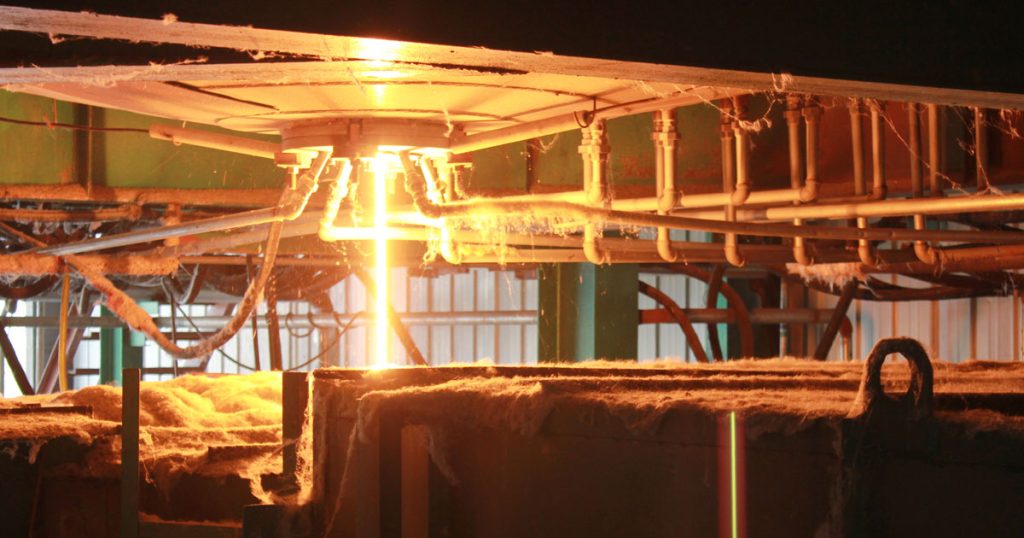
Step 3 – Fiberizing The molten stuff comes out through a molybdenum spout. It hits spinning discs. Three or four discs in a row. Each disc spins at thousands of RPM. The melt flies off and becomes fibers. Diameter is 2 to 5 microns. That’s the sweet spot. Too thick – bad insulation. Too thin – weak blanket.
Step 4 – Web forming Fibers get blown onto a moving mesh belt. A suction box underneath pulls them down. This makes a uniform mat called a web. The web thickness depends on conveyor speed. Slow speed = thick blanket. Fast speed = thin blanket. We can do 6mm up to 100mm.
Step 5 – Needling Now the web goes into the needling machine. Ours is double‑sided. Needle boards from above punch down. Boards from below punch up. Thousands of barbed needles push fibers together. They tangle and lock. No glue. Just mechanical entanglement.
We can adjust needling density. For low density blankets (64 kg/m³), less needling. For high density (160 kg/m³), more needling and slower speed.
Step 6 – Heat treatment The blanket still has some organic lubricant from fiberizing. If we don’t burn that off, the blanket will smoke when the customer first heats it. Not good. So the blanket goes through a hot furnace, multiple temperature zones. Burning off organics. Also causing microcrystallization – this locks in the blanket’s heat resistance.
Step 7 – Cutting and winding After cooling, the blanket goes through slitting knives to cut to width. Standard is 610mm or 600mm. Then a cross cutter cuts to length – 3.6m, 7.2m, whatever. Then winding. Tension control so the rolls are tight and even. Finally packaging – shrink film or woven bags.
All of this is controlled from one PLC touchscreen. One operator per shift. That’s an automatic ceramic fiber blanket manufacturing plant.
What Blanket Grades Can You Make?
With our ceramic fiber blanket production line, you can switch between four main grades:
- Standard grade – 1260°C classification. Use up to 1000°C. General industrial insulation. Most common.
- High‑purity grade – Same 1260°C but lower impurities. Less shrinkage at high temperature.
- High‑alumina grade – Alumina over 50%. Classification 1400°C. For hotter furnaces.
- Zirconia grade – Added zirconium dioxide. Classification 1430°C. Service up to 1350°C. Most expensive but highest margin.
Switching grades takes about 30 minutes. Change the raw material recipe. Adjust a few parameters. Good to go.
Real Talk – What Problems Will You Face?
I’m not going to pretend everything is perfect. Running a ceramic fiber blanket production line has challenges.
Fiber diameter control is hard. If your spinning discs wear out, fibers get thicker. Thicker fibers = worse insulation. You’ll need to replace discs every so often. How often? Depends on hours run. Typically 6-12 months for heavy use.
Needle breakage happens. Needles are consumables. They snap. Keep spares. Train your operators to check for broken needles regularly. A broken needle can scratch the blanket surface.
Dust. The process makes fine dust. You need good ventilation. Also your workers should wear masks. We include dust collection ports in our design but your local exhaust system is your responsibility.
Raw material quality varies. Not all alumina powder is the same. Impurities affect blanket performance. Test your raw materials before buying big batches.
I tell customers all this upfront. Better to know than to be surprised.
Why Jinyuan?
I started Jinyuan because I saw so many bad machines. Traders selling junk. No support. Customers left stranded.
We’re not the biggest ceramic fiber blanket production line manufacturers. But we’re one of the most honest.
Here’s what you get with us:
- You visit the factory. See your line being built. Or visit a running line at another customer’s plant.
- We do installation. Our engineers travel to your site. Stay 2-4 weeks. Train your people until they can run it alone.
- Spare parts ready. We stock common items. Ship within 48 hours usually.
- Remote support. WhatsApp, WeChat, Skype. We answer even on weekends. Because breakdowns don’t wait for Monday.
- Custom design. Need CE certification? Different voltage? Special width? Tell us. We change the design.
Also, we keep the cost of aluminum silicate blanket production line reasonable. Because we’re direct manufacturers. No middleman markup.
One Example – Uzbekistan Customer
Let me tell you about a guy in Uzbekistan. He had a small insulation business. Bought blankets from China. Took two months delivery each time. He came to our factory, saw the ceramic fiber blanket production line, asked a million questions. Then he said “I want one.”
We built him a 2,000 tons/year line. Electric furnace (gas was unreliable there). 1,200mm width. Semi-automatic – not fully automatic because his operators weren’t highly skilled.
We shipped it. My team went there for installation. Took five weeks. The first blankets were not perfect – we adjusted parameters, trained his guys more. By week four, they were making good product.
Now he produces his own blankets. Lead time for his customers? Three days. He’s the cheapest supplier in his region. His business grew by 30% last year.
That’s what a good ceramic fiber blanket production line can do.
FAQs – Quick Answers
How much floor space? About 1,500 to 4,000 square meters depending on line size.
How many workers? Four to six people per shift. One on furnace, one on needling/cutting, one packing, one supervisor.
Can I expand later? Yes. We design with future expansion in mind. Add more needling stations or a wider oven later.
Do you buy back old lines? No. But we help you resell to other buyers sometimes.
What payment terms? Typically 30% deposit, 40% before shipping, 30% after installation acceptance. Can discuss.
Warranty? 12 months. Extended warranty available.
Last Words
Look. Buying a ceramic fiber blanket production line is a big decision. Don’t rush. Don’t just look at price. Look at the supplier. Look at their factory. Talk to their customers.
If you contact Jinyuan, I promise you’ll get honest answers. If our line isn’t right for you, I’ll tell you. But if it is right, we’ll work hard to make you successful.
That’s the only way we stay in business for fifteen years.
Come visit our factory in Shandong. See the automatic ceramic fiber blanket manufacturing plant running. Touch the blankets. Ask any question.
Then decide.
Jinyuan – building ceramic fiber blanket production line equipment since 2008.